
The Regulatory Architect
Navigating the CSRD/ESRS Shift: Systems-Thinking for Global Value Chains
Executive Summary
As the 2026 regulatory deadline for the Corporate Sustainability Reporting Directive (CSRD) approaches, organizations face a fundamental shift from narrative-driven sustainability to data-driven financial disclosure. This case study details the role of Robin Boustead, Director of SustainGenix, as a Technical Advisor to EFRAG (European Financial Reporting Advisory Group) and the author of the ESG Reporting Manual.
By integrating technical expertise across five critical sectors—Textiles, Tourism, Agriculture, IT, and Light Manufacturing—this project demonstrates how “Systems-Thinking” identifies hidden impacts, mitigates transition risks, and builds a robust architecture for adaptation across the entire global value chain.
The Global Challenge: The Complexity of Double Materiality
The introduction of the European Sustainability Reporting Standards (ESRS) has exposed a critical "knowledge gap" in global industry. Most organizations view sustainability in silos, failing to account for the Double Materiality required by law:
- Impact Materiality:How a company’s operations affect people and the planet (the “Inside-Out” view).
- Financial Materiality:How sustainability-related risks—such as climate volatility or resource scarcity—affect a company’s financial health (the “Outside-In” view).
SustainGenix was positioned at the heart of this transition, providing the technical logic for sectors where impacts are often deeply embedded in remote, low-data supply chains.
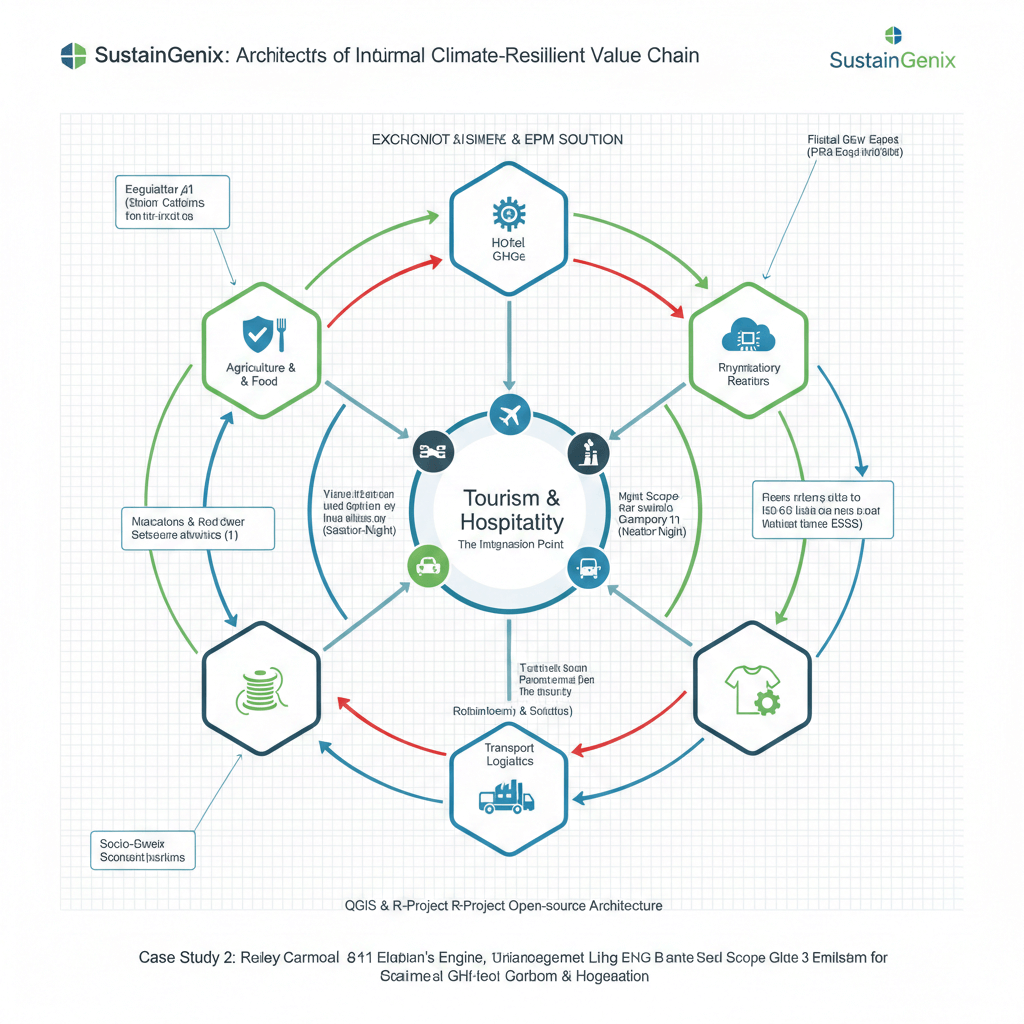
Systems-Thinking: Mapping Five Critical Value Chains
The “SustainGenix Edge” lies in Robin Boustead’s ability to see the tourism sector not as an isolated industry, but as a nexus of Agriculture, IT, Textiles, and Manufacturing. During his tenure at EFRAG, this systems-level view allowed for a more forensic analysis of sectoral impacts.
1
Textiles & Garments: The Human-Environment Nexus
In the textile sector, impacts are concentrated in water intensity and labor rights. SustainGenix applied a “Forensic Lens” to mapping the journey from raw fiber to finished garment.
- Impact Mitigation: Identifying chemical runoff and microplastic shedding as primary environmental impacts.
- Adaptation: Moving toward circularity and regenerative fiber sourcing to mitigate the financial risk of future carbon taxes on “fast fashion” waste.
2
Agriculture & Food Systems: The Resilience Pillar
Drawing from inter-governmental work with Invest International, SustainGenix analyzed the agricultural supply chain as the foundation of the hospitality and retail sectors.
- Impact Mitigation:Quantifying the footprint of “Field-to-Table” logistics.
- Adaptation: Developing climate-resilient irrigation and soil-health frameworks that protect food security against thermal anomalies
3
Information Technology (IT): The Invisible Footprint
Often overlooked in tourism, the IT sector provides the digital architecture for EPM (Enterprise Performance Management) systems.
- Impact Mitigation:Addressing the energy intensity of data centers and the “e-waste” lifecycle.
- Adaptation:Leveraging AI and machine learning to optimize resource allocation, turning IT into a tool for Administrative Burden Reduction.
4
Light Manufacturing: The Circularity Opportunity
From hotel amenities to trekking equipment, light manufacturing is the “Hardware” of the tourism industry.
- Impact Mitigation:Evaluating Scope 1 and 2 emissions in production facilities.
- Adaptation:Re-engineering product lifecycles to meet the EU Taxonomy for sustainable activities.
5
Tourism & Hospitality: The Integration Point
Tourism acts as the final aggregator of all the above sectors. By understanding the inputs (Food, Tech, Textiles), SustainGenix provides NTOs with a holistic view of their Scope 3 (Category 11) exposure.
Technical Authority: The ESG Reporting Manual
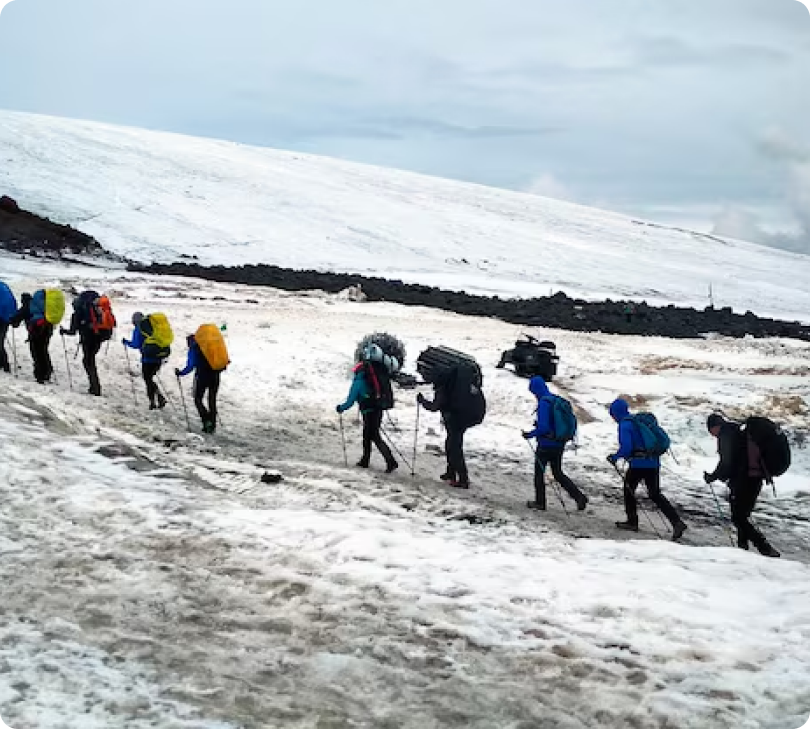
Using QGIS and Copernicus C3S satellite data, we conducted a forensic spatial audit of the GHT corridor.
This manual serves as the technical “Bible” for organizations navigating ESRS, GRI, and IFRS compliance. It distills complex legal requirements into actionable strategies, ensuring that reports are not just compliant, but “Audit-Ready.”
The Manual’s Core Frameworks:
- The 500-Point Audit:A forensic checklist for verification.
- Gap Analysis Logic:Identifying the “Missing Data” in Scope 3 reporting.
- Interoperability Protocols:Ensuring data flows seamlessly between different global standards (IFRS vs. ESRS).
Methodology: The "Source-to-Scorecard" Pipeline
SustainGenix applies a rigorous 4-step process to value-chain transformation:
Forensic Mapping:
Identifying the "Primary Impacts" in the furthest reaches of the supply chain.
Double Materiality Stress-Testing:
Applying the EFRAG-vetted logic to determine which impacts are financially material to the board.
Mitigation Architecture:
Developing EPM software solutions that track real-time GHGe data (utilizing the Carmacal logic).
Adaptation Strategy:
Building a "Transition-Ready Vault" that identifies Stranded Assets and climate-safe investment zones.
Leadership & Capacity Building
A systems-thinker must also be a capacity-builder. Through SustainGenix, Robin Boustead has coached 170+ companies, from SMEs in the Himalayas to multinationals in Europe.
Intercultural Leadership:
Bridging the gap between the “High-Level Policy” of Brussels and the “Ground-Level Reality” of a teahouse in Nepal or a textile factory in Thailand.
Mentoring & Training:
Developing auditor training resources that integrate ISO standards with the latest EU mandates (CSRD/ESRS).
Results: The ROI of Systems-Thinking
By viewing the world through a systems-thinking lens, SustainGenix has achieved:
- For EFRAG:Technical lead for sustainability-related impact assessments across multiple high-impact sectors.
- For Clients:Transforming ESG from a “compliance cost” into a tool for operational resilience and Green Financing.
- For the Industry:Establishing the ESG Reporting Manual as the gold standard for navigating the 2026 regulatory shift.
Conclusion: The Sherpa of the Green Transition
Robin Boustead’s trajectory from the Great Himalaya Trail to Technical Advisor at EFRAG proves that the math of sustainability is universal. Whether mapping the erosion of a mountain path or the financial risk of a textile supply chain, the goal is the same: Resilience through Data Sovereignty.
With the publication of the ESG Reporting Manual, SustainGenix provides the technical architecture for organizations to lead the climate transition, rather than be disrupted by it.



